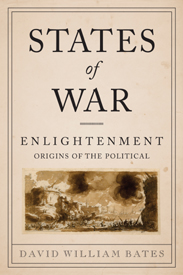
States of War: Enlightenment Origins of the Political (Columbia University Press, 2012)
by David Bates – Professor of Rhetoric at UC Berkeley and Director of the Berkeley Center for New Media
 States of War addresses one of the most pressing concerns of modern democratic states: how to reconcile the foundational drive to defend the nation with the principles of law and civic rights? Conceptually and historically, these two important dimensions of the modern state–sovereignty and the rule of law–have distinct roots.
Sovereignty emerged in the seventeenth century as the idea and practice of absolutism, where the final decision rested with the monarch. In the eighteenth century, new ideas of the state emphasized the constitutive role of individuals with natural rights in the formation of a legitimate political community. Of course, these Enlightenment ideas had immense influence on the development of constitutional states in the revolutionary period and beyond.
This book approaches the conceptual dilemma at the heart of the constitutional state by looking carefully at the history of modern political thought. The argument is that the Enlightenment is not simply the moment when intellectuals developed origin stories of political organization as a way of highlighting the fundamental rights of individuals. Instead, in the eighteenth century, intellectuals were the first to develop a thorough conceptualization of political power as an autonomous sphere of activity that was legitimated by its existential responsibilities. However, the great achievement of this period was the development of a theory of legality and civic rights that was not in opposition to this existential logic, but in fact derived from it directly.
http://cup.columbia.edu/book/978-0-231-15804-6/states-of-war